

- Published on
AI-Powered Rug Pull Detection: How It Works and Where It Fails
Listen to the full article:
- Authors

- Name
- Jagadish V Gaikwad
What is AI-powered rug pull detection?
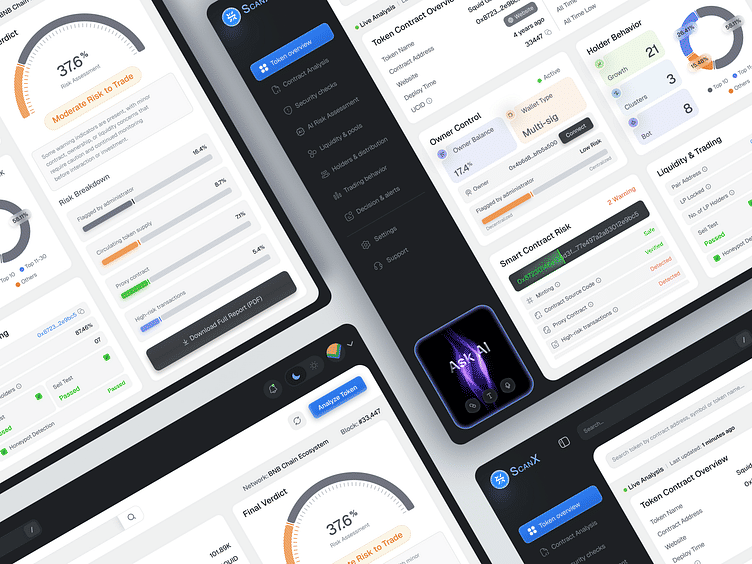
AI-powered rug pull detection uses machine-learning models and blockchain analytics to identify token projects that may be preparing to abandon investors, drain liquidity, manipulate trading, or restrict withdrawals. It is best understood as an early-warning system, not a verdict that a token is safe or fraudulent.
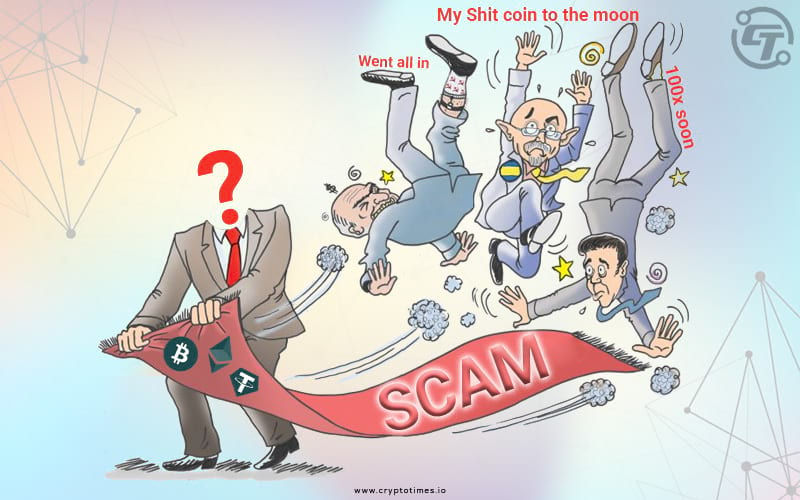
A rug pull occurs when people associated with a crypto project create the appearance of a functioning market, attract buyers, and then remove value or control. Common mechanisms include withdrawing decentralized-exchange liquidity, selling concentrated token holdings, changing smart-contract permissions, or making it difficult for holders to sell. Chainalysis describes rug pulls as scams in which developers build apparently legitimate projects before taking investors’ money and disappearing.
The detection problem is difficult because a model usually has to assess a token before the decisive event occurs. At that point, the same signals can describe either a malicious launch or a legitimate project experiencing normal early volatility.
Why simple token checks are not enough
A basic token scanner may check whether a contract is verified, whether liquidity is locked, or whether ownership has been renounced. Those checks can be useful, but they capture only a narrow part of the risk.
A project can present clean-looking contract metadata while still exposing investors to:
- Concentrated ownership by a deployer or related wallets
- Transfer restrictions that appear only under certain conditions
- Unusual changes to taxes, fees, or trading permissions
- Liquidity controlled by a small group
- Coordinated buying followed by rapid distribution
- Developer wallets connected to earlier failed projects
- Social promotion that creates attention without durable participation
AI systems improve on one-rule screening by combining many observations. Instead of asking whether a single warning sign exists, they estimate whether the overall pattern resembles previously labeled scam or non-scam activity.
That distinction matters. A token with an unlocked liquidity position is not automatically a rug pull, and a token with locked liquidity is not automatically safe. The meaningful question is how several risk factors interact over time.
What data do detection models use?
The strongest systems generally combine several categories of evidence. Each category reveals a different part of the project’s behavior.
Smart-contract and permission data
Contract analysis examines what the code allows authorized accounts to do. Relevant features may include whether an owner can mint new tokens, pause transfers, blacklist addresses, alter fees, or redirect funds.
These capabilities do not prove malicious intent. Some are legitimate administrative controls, while others create material exit risk. A useful system therefore records who controls each permission, whether the permission can be transferred, and whether changes are visible on-chain.
Static analysis can also identify suspicious code patterns. However, contract-only systems may miss scams executed through ordinary token contracts, multisignature decisions, liquidity management, or coordinated wallets.
Liquidity and market-state data
Liquidity is the pool of assets available for trading. When a project’s liquidity is removed or becomes too shallow, holders may be unable to sell without severe price impact.
Models can monitor:
- The amount and concentration of liquidity
- Whether liquidity providers can withdraw
- Large additions or removals
- Changes in the relationship between token volume and available liquidity
- Slippage and price impact
- Sudden trading inactivity after promotional activity
A liquidity drain is often a late-stage signal. Early models try to identify the conditions that make a drain more plausible before it happens.
Wallet and transaction behavior
On-chain transactions form a behavioral record. Models can examine whether wallets connected to the deployer receive large allocations, whether supposedly independent buyers fund themselves from common sources, and whether early holders distribute tokens in coordinated patterns.
Graph-based methods treat addresses and transactions as a network rather than as isolated events. This can reveal clusters of wallets, shared funding paths, repeated deployer behavior, and links to previously labeled incidents.
The Solana Rug Pull Dataset, known as SolRPDS, was created from Solana transaction data to support systematic rug-pull identification. Research on Solana has also explored detection using on-chain transaction and state data without relying on external social-media information.
Social and external signals
Some systems add open-source intelligence, or OSINT, such as public social activity, search interest, project announcements, and changes in promotional behavior. These signals can help identify coordinated hype or abrupt disappearance.
They also introduce new risks. Social metrics can be purchased, botted, copied, or manipulated. A model should treat them as contextual evidence rather than proof of legitimacy.
A recent leakage-resistant research framework combined on-chain behavior with temporally aligned OSINT signals, meaning the features were restricted to information available before the suspected liquidity withdrawal. That temporal restriction is important because using information that became available after an incident can make a model look more accurate than it would be in real use.
How machine learning turns signals into a warning
A typical workflow has five stages:
- Collect data. The system gathers contract states, transactions, liquidity events, wallet relationships, and possibly external signals.
- Define the outcome. Researchers decide what counts as a rug pull, such as a catastrophic liquidity withdrawal or prolonged abandonment.
- Create features. Raw blockchain activity is converted into measurable indicators, such as wallet concentration or the rate of liquidity change.
- Train and test a model. Historical examples are labeled and separated into training and evaluation periods.
- Set an alert threshold. The system converts a probability or score into actions such as review, warning, or blocking.
Common approaches include gradient-boosted decision trees, logistic regression, neural networks, and graph models. Gradient boosting is often attractive for structured blockchain data because it can handle nonlinear relationships and mixed feature types.
Recent research on Solana reported that gradient-boosting models could identify potential fraudulent memecoins using only the first five minutes of trading data. That result is promising, but it should not be read as a universal guarantee. The study concerns a particular ecosystem, dataset, time period, labeling process, and definition of fraud.
Research on the TON blockchain similarly compared liquidity-based and inactivity-based definitions of a rug pull. The study found that different definitions favored different performance goals, with one approach producing stronger discrimination and another improving recall. This illustrates a central trade-off: a model optimized to catch more suspicious tokens will usually flag more legitimate ones.
Detection approaches compared
| Approach | Main evidence | Strength | Main limitation | Best use |
|---|---|---|---|---|
| Contract screening | Permissions and code patterns | Finds explicit administrative risks early | May miss wallet coordination and off-chain deception | First-pass technical review |
| Rule-based monitoring | Fixed thresholds for liquidity, ownership, or transfers | Easy to explain and audit | Adversaries can adapt around known rules | Transparent alerts |
| Machine learning on tabular data | Aggregated transaction and market features | Finds combinations of signals at scale | Depends heavily on labels and timing | Ranking tokens for review |
| Graph-based analysis | Wallet, funding, and transaction relationships | Detects connected actors and repeated behavior | Computationally and operationally complex | Investigating wallet networks |
| Multimodal detection | On-chain data plus OSINT | Adds context beyond the ledger | Social data can be manipulated or unavailable | Human-assisted risk assessment |
No single approach covers every failure mode. In practice, a layered system is more defensible than an opaque score shown without explanation.
The most important evaluation problem: leakage
Data leakage occurs when training or evaluation includes information that would not have been available at the time an alert was supposed to occur. For example, a model may use a liquidity-withdrawal event to predict the same liquidity withdrawal. That can produce impressive test results while failing as an early-warning tool.
A credible evaluation should therefore:
- Use only information available before the prediction timestamp
- Separate training and test periods to reduce temporal contamination
- Avoid splitting highly related wallets across both sets without care
- Report precision, recall, and false-positive rates
- Test performance across chains, token types, and market conditions
- Explain how labels were created
- Compare performance against simple rules and human review
Precision answers how often flagged projects are actually labeled as rugs. Recall answers how many labeled rugs the system catches. Neither metric is sufficient alone.
A platform that blocks trading needs a different threshold from a research dashboard that merely prioritizes manual investigation. The cost of a false positive may include lost access to a legitimate launch, while the cost of a false negative may include investor losses and reputational damage.
Why AI cannot prove that a token is safe
AI detection has several structural limitations.
Labels are incomplete. Many scams are never formally identified, and some projects fail without fraudulent intent. A dataset can therefore contain ambiguous or incorrect labels.
Scams evolve. Attackers can change contract patterns, distribute ownership across wallets, or imitate the behavior of legitimate projects. A model trained on older incidents may degrade as tactics change.
Early data is sparse. New tokens may have only a few minutes of trading history. A score based on limited activity should carry more uncertainty than a score based on weeks of behavior.
Chain context differs. Wallet behavior, liquidity architecture, and token-launch conventions vary across Ethereum, Solana, TON, and other networks. A model that performs well on one chain may not transfer cleanly to another.
Correlations are not intent. A concentrated supply or aggressive marketing campaign can be risky without proving fraud. Models identify patterns associated with outcomes; they do not read the creators’ intentions.
Scores can create false confidence. Users may interpret a low-risk label as approval. Any interface should show the underlying reasons, timestamp, data coverage, and uncertainty rather than presenting a single number as a guarantee.
A practical workflow for evaluating a token
AI should support due diligence rather than replace it. Before interacting with a token, use the model’s alert as a starting point and ask:
1. What exactly does the score measure?
Check whether the system predicts contract risk, liquidity removal, trading inactivity, wallet coordination, or a broader scam label. These are different outcomes.
2. How current is the evidence?
A score generated before a major contract change may no longer describe the token. Look for the last update time and whether the system tracks permission changes and liquidity events continuously.
3. Which signals caused the warning?
Prefer tools that explain the alert with concrete observations, such as concentrated ownership, mutable fees, connected wallets, or unusual liquidity movement.
4. Can the project withstand an exit?
Review who controls liquidity, whether holders can sell, and whether a small number of wallets could materially affect the market. Avoid treating a lock or audit badge as complete protection.
5. What remains unverified?
Unknown team identity, unverifiable claims, copied documentation, and manipulated social proof should remain unresolved risks. Do not convert missing data into a favorable assumption.
How developers can build better detectors
A reliable detector needs more than a sophisticated model. It needs disciplined data design and careful operations.
Start with an explicit threat model. Define whether the system is intended to detect liquidity theft, honeypots, contract abuse, coordinated dumping, abandonment, or several categories separately. One broad label can conceal important differences.
Use time-aware datasets. Features must be frozen at the time of each prediction, and post-incident information should be excluded. Keep a holdout period that reflects how the system will operate after deployment.
Combine interpretable rules with statistical models. A rule can explain that a privileged account changed a transfer fee, while a model can identify a less obvious combination of wallet and liquidity behavior. Showing both makes investigation easier.
Monitor drift. Track whether alert rates, feature distributions, and error patterns change as launch practices and attacker tactics evolve. Retrain only after checking that new labels are reliable.
Design for human review. Alerts should include evidence, confidence limitations, and a clear timestamp. They should not automatically accuse identifiable people or treat an address association as proof of criminal conduct.
Finally, test adversarially. Assume that attackers will learn which features trigger alerts. Evaluate whether the system still works when wallets are split, funding routes are varied, social signals are inflated, or benign behavior is deliberately imitated.
What readers should look for in an AI detector
A credible product or research tool should disclose:
- The chains and token types covered
- The definition of a rug pull
- The data timestamp and refresh interval
- Whether the score is predictive, descriptive, or based on known incidents
- Evaluation metrics and the test-period design
- The number and quality of labeled examples
- Reasons behind each warning
- Known blind spots and unsupported cases
Claims such as “detects every scam” or “guarantees safe tokens” should be treated as marketing, not evidence. Even strong academic results apply to the studied data and assumptions, not to every future launch.
Conclusion
AI-powered rug pull detection is most useful as a structured way to surface risk before a damaging event becomes obvious. It can combine contract permissions, liquidity behavior, wallet relationships, market activity, and carefully timed external signals faster than manual review alone.
Its value depends on the details: honest labels, leakage-resistant testing, chain-specific validation, interpretable alerts, and continuous monitoring. A high score should prompt investigation, while a low score should never be treated as proof of safety.
The safest decision process combines automated screening with independent contract, liquidity, and wallet checks. Treat every prediction as dated and probabilistic, verify what the model actually measured, and keep the possibility of unseen failure modes in view.
You may also like
- SaaS SEO: How to Rank Your Software Organically in 2025
- Best AI Tools for Crypto Research and Portfolio Analysis in 2026
- Startup Mistakes AI Can Help You Avoid: The Founder’s Playbook for 2026
- Serverless AI: Build Smarter Apps with Fewer Resources in 2025
- Unlock Ultimate Gaming Power with 3 AirGPU Remote Gaming Rigs in 2025