

- Published on
How AI Can Detect DeFi Liquidation Risk
Listen to the full article:
- Authors

- Name
- Jagadish V Gaikwad

Decentralized finance lending protocols allow users to borrow against crypto collateral without a traditional bank. That flexibility creates a critical risk: when collateral loses value or debt grows, a position can become undercollateralized and be liquidated.
AI can detect DeFi liquidation risk by combining protocol data, market conditions, blockchain activity, and scenario analysis. It can estimate which positions are approaching their liquidation threshold, rank them by urgency, and identify market conditions that could trigger multiple liquidations. However, AI does not replace the protocol’s liquidation rules or guarantee an accurate prediction.
What DeFi liquidation risk means
In a lending protocol, a borrower deposits collateral and receives a loan against it. The protocol assigns risk parameters to each asset, including the loan-to-value ratio and liquidation threshold.
A liquidation occurs when the collateral no longer provides enough risk-adjusted value to support the outstanding debt. On Aave, for example, the health factor measures the safety of a borrowing position. A health factor below 1 indicates that the position is eligible for liquidation, subject to the protocol’s other conditions and current oracle data. Aave’s explanation of health factors and liquidations describes how collateral value, liquidation thresholds, and debt combine to determine this status.
Liquidators repay some or all of the borrower’s debt and receive collateral, usually with an incentive known as a liquidation bonus. The process helps protect lenders, but it can impose losses on borrowers through seized collateral, penalties, slippage, and transaction costs.
The key point for AI systems is that liquidation risk is not a single number. It is a changing relationship among:
- Collateral prices
- Borrowed asset prices
- Accruing interest
- Collateral liquidation thresholds
- Borrower leverage
- Oracle behavior
- Market liquidity
- Blockchain congestion
- The borrower’s ability to add collateral or repay debt
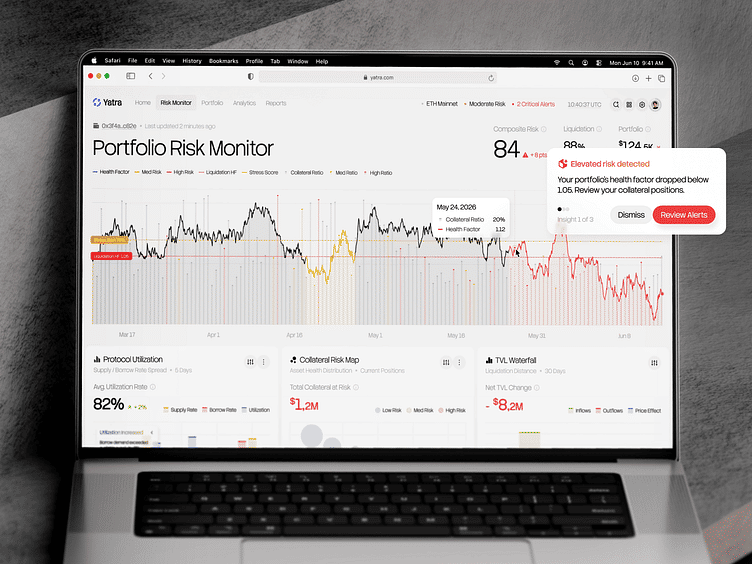
A simple monitoring system may watch the current health factor. An AI system can go further by estimating how that factor may change under several plausible conditions.
How AI detects liquidation risk
AI-based risk detection generally combines deterministic calculations with statistical or machine learning models. The deterministic layer calculates the position according to the protocol’s rules. The predictive layer estimates what could happen next.
1. It reconstructs each borrowing position
The system first gathers on-chain data for every relevant wallet and protocol market. Typical inputs include:
- Supplied collateral
- Borrowed assets
- Current debt balances
- Interest rates and accrued interest
- Asset prices from approved oracle feeds
- Liquidation thresholds
- Existing health factors
- Previous deposits, withdrawals, repayments, and borrow transactions
This step is more difficult than reading a token balance. A wallet may supply several collateral assets, borrow multiple assets, use a particular risk mode, or interact with more than one protocol. The monitoring system must apply the protocol’s actual accounting rules rather than a generic lending formula.
A useful data pipeline therefore needs protocol-specific adapters, historical snapshots, and checks for stale or inconsistent data. If the reconstructed position is wrong, the model’s risk score will also be wrong.
2. It calculates the current risk state
The first output is usually a current risk classification. For example, a position might be labeled:
- Healthy with a substantial buffer
- Near the liquidation threshold
- Vulnerable to a moderate price move
- Highly exposed to a rapid market shock
- Currently eligible for liquidation
The health factor is valuable because it compresses several risk variables into one operational measure. Yet it should not be treated as a complete forecast. Two positions with similar health factors can have very different risks if one uses a highly liquid collateral asset and the other uses a thinly traded token.
AI adds context by examining the distance to liquidation together with volatility, liquidity, concentration, and borrower behavior.
3. It forecasts collateral and debt movements
Machine learning models can analyze historical prices, volatility, correlations, funding conditions, and market-wide stress indicators to estimate possible future movements.
A model might ask:
- How likely is the collateral to fall by a particular percentage over the next hour?
- How quickly could the position cross its liquidation threshold?
- What happens if the borrowed asset strengthens against the collateral?
- Are several collateral assets becoming more correlated?
- Is current volatility different from the conditions represented in the training data?
The goal is not to predict the exact next price. A more useful objective is estimating the probability that a position enters a dangerous state within a defined time window.
A published study on Compound V2 explored machine learning models for predicting borrower behavior and liquidation-related outcomes. It reported that Random Forest and XGBoost models performed well in its framework, with collateral values, historical risk exposure, and asset composition among the relevant features. The study is available through HAL. Its findings should be treated as research evidence for a particular dataset and methodology, not as proof that one model will work across every chain or market.
4. It models borrower behavior
Liquidation risk depends partly on what the borrower does next. A borrower may repay debt, add collateral, move assets, or do nothing.
AI can analyze wallet history to identify behavioral patterns such as:
- Frequent collateral top-ups
- Regular debt repayments
- Increasing leverage during rallies
- Delayed responses to falling prices
- Repeated use of the same assets
- Cross-protocol borrowing
- Transfers to or from centralized exchanges
These signals can help distinguish a position that is technically close to liquidation but actively managed from one whose owner has not responded to worsening conditions.
Behavioral prediction is inherently uncertain. Wallet activity may change suddenly, and a new wallet may have too little history for reliable classification. The model should therefore use behavior as one input rather than assuming past actions determine future decisions.
5. It detects correlated and systemic risk
A liquidation engine focused on individual wallets can miss broader market structure. If many borrowers use the same collateral asset, a price decline can make numerous positions vulnerable at once.
AI can group positions by shared exposure:
- The same collateral token
- The same oracle feed
- The same lending protocol
- The same liquidity venues
- The same borrower or wallet cluster
- The same stablecoin or debt asset
It can then estimate whether liquidations are likely to reinforce the original decline. Forced collateral sales may increase market supply, while falling liquidity can increase slippage. That combination can push additional positions toward liquidation.
This is a form of network risk analysis. The model is not merely asking, “Which wallet is closest to liquidation?” It is asking, “Which group of positions could become dangerous together?”
What data an AI risk model needs
The quality of a liquidation-risk detector depends heavily on data quality and timing. The most useful inputs usually fall into four groups.
| Data category | Examples | Why it matters |
|---|---|---|
| Position data | Collateral, debt, health factor, thresholds, interest accrual | Establishes the current liquidation distance |
| Market data | Price, volatility, liquidity, spreads, trading volume | Estimates how quickly risk may change and how costly exits may be |
| Blockchain data | Wallet actions, protocol events, gas conditions, oracle updates | Reveals borrower behavior and execution constraints |
| Stress indicators | Correlations, concentration, bridge exposure, protocol utilization | Identifies clustered or cascading liquidation risk |
The system also needs timestamps and historical snapshots. A model trained only on end-of-day data may fail during a rapid market move because liquidations can occur between snapshots.
Data provenance matters as well. Oracle prices, decentralized exchange prices, and centralized exchange prices may differ temporarily. An AI system should record which source produced each feature and whether that source was fresh, delayed, or unavailable.
A practical AI detection workflow
A robust monitoring workflow can be organized into six stages.
Stage 1: Ingest protocol and market data
Collect lending positions, reserve parameters, oracle values, price feeds, liquidity measures, and blockchain events. The system should support chain reorganizations, delayed indexing, and changes to protocol parameters.
Stage 2: Recalculate positions
Use the protocol’s current rules to recompute collateral value, debt value, liquidation thresholds, and health factors. Do not rely solely on a third-party dashboard if the objective is automated risk management.
Stage 3: Create predictive features
Useful features can include recent price changes, realized volatility, liquidity depth, collateral concentration, debt growth, utilization, wallet response history, and the time since the last position adjustment.
Stage 4: Generate scenario outcomes
Run scenarios such as:
- A moderate collateral decline
- A rapid collateral decline
- Higher borrowing costs
- A debt-asset price increase
- Reduced market liquidity
- A delayed transaction caused by network congestion
- A temporary oracle disruption
The output should show how much buffer remains under each scenario and which assumptions drive the result.
Stage 5: Rank alerts
A useful alert system prioritizes positions by more than their current health factor. It can combine liquidation distance, estimated time to threshold, position size, market liquidity, concentration, and confidence in the data.
Stage 6: Apply human or rule-based review
For high-value positions, AI-generated alerts should be checked against protocol documentation, current governance parameters, oracle status, and execution conditions. Automated action may be appropriate for narrowly defined tasks, but an unreviewed model should not control significant funds.
AI methods that fit this problem
Different methods answer different risk questions.
Classification models
A classification model estimates whether a position will enter a defined risk state within a chosen period. The target might be “liquidated within one hour” or “falls below a specified safety buffer.”
Classification is easy to operationalize, but the result depends on the label definition and time horizon. A model trained on one protocol’s liquidation rules may not transfer cleanly to another.
Regression models
Regression estimates a continuous outcome, such as expected health-factor change or potential loss under a scenario. It can help rank positions by projected deterioration.
The weakness is that extreme events are difficult to model. Averages may look accurate while missing rare, high-impact price shocks.
Time-series models
Time-series methods analyze sequential observations such as prices, volatility, utilization, and health factors. They can identify trends and changing market regimes.
They remain vulnerable to regime shifts. Historical relationships can break when a stablecoin depegs, an oracle changes behavior, or liquidity disappears.
Anomaly detection
Anomaly detection identifies unusual wallet actions, price movements, utilization changes, or oracle updates. It is useful when labeled liquidation examples are limited.
An anomaly is not automatically a threat. A large repayment may be a risk-reducing action, while an unusual transfer may have no connection to liquidation.
Graph-based models
Graph methods represent relationships among wallets, assets, protocols, pools, and oracles. They can help identify shared exposures and likely contagion paths.
These models require careful entity resolution. Treating every related wallet as the same owner can create false conclusions, while failing to connect related addresses can hide concentration risk.
AI prediction versus rule-based monitoring
AI should complement protocol rules rather than replace them.
| Approach | Strength | Limitation | Best use |
|---|---|---|---|
| Rule-based health-factor monitor | Transparent and aligned with protocol mechanics | Usually reacts to current conditions rather than forecasting them | Exact liquidation eligibility and basic alerts |
| Scenario engine | Explains how price or liquidity changes affect a position | Depends on chosen assumptions | Stress testing and decision support |
| Supervised machine learning | Can rank positions and identify nonlinear patterns | Sensitive to training data and regime changes | Short-horizon risk prioritization |
| Anomaly detection | Finds unusual behavior or market conditions | Alerts may not represent actual liquidation risk | Early warning and investigation |
| Graph analysis | Reveals shared exposures and cascading pathways | Complex data preparation and interpretation | Systemic and cross-protocol risk |
The most defensible architecture is usually layered: protocol calculations for correctness, scenario analysis for transparency, and machine learning for prioritization.
Key limitations and failure modes
AI liquidation detection has several important weaknesses.
Bad data creates confident errors
A stale oracle, missing event, incorrect token decimal, or indexing delay can distort the entire risk assessment. Confidence scores do not repair flawed inputs.
Liquidations are path-dependent
The final result depends on transaction ordering, gas prices, liquidity, slippage, and competing liquidators. A position can move from apparently safe to liquidated before a warning is acted upon.
Training data may be biased
Historical data often contains more normal periods than crisis periods. A model may perform well during calm conditions and fail precisely when volatility, correlation, and liquidity change together.
Protocol parameters can change
Governance may adjust collateral factors, liquidation thresholds, caps, interest-rate curves, or oracle configurations. The model must detect and incorporate those changes promptly. A historical model cannot safely assume parameters are permanent.
False positives have costs
Too many warnings can cause unnecessary deleveraging, increased trading costs, and alert fatigue. Too few warnings can leave operators unaware of imminent risk. Thresholds should be evaluated using both missed events and unnecessary alerts.
Prediction can create feedback loops
If many users receive the same warning and sell the same collateral, the alert itself may contribute to price pressure. Risk systems should account for the possibility that large-scale responses change the conditions being predicted.
How to evaluate an AI liquidation detector
Accuracy alone is not enough. A useful evaluation should include:
- Precision: how many high-risk alerts were genuinely useful
- Recall: how many relevant liquidation events the system detected
- Lead time: how much warning it provided before the risk event
- Calibration: whether a stated probability matches observed frequency
- Performance during stress: how the model behaves during sharp declines
- Transferability: whether it works across assets, chains, and protocols
- Execution realism: whether alerts account for gas, slippage, and transaction delays
- Explainability: whether an operator can identify the main risk drivers
Backtesting should avoid data leakage. Future information must not appear in training features, and evaluation should include periods that differ from the training sample. Walk-forward testing, stress periods, and simulated execution are more informative than a single historical accuracy score.

A safer implementation pattern
For a protocol operator, risk team, or portfolio dashboard, a practical design might follow these principles:
- Treat on-chain protocol calculations as the source of truth for current eligibility.
- Store historical position states so the system can measure deterioration.
- Separate market forecasts from deterministic liquidation calculations.
- Show the assumptions behind every scenario.
- Attach data freshness and model-confidence indicators to alerts.
- Recalculate after governance, oracle, or reserve-parameter changes.
- Test models during liquidity shocks and correlated asset declines.
- Keep automated actions limited, reversible, and subject to explicit risk limits.
- Log every alert, input, model version, and decision for later review.
- Monitor false positives and missed events continuously.
For borrowers, the practical output should be understandable: current buffer, estimated sensitivity to price changes, available repayment options, and the risks of each response. For liquidators, the output should additionally include expected collateral value, transaction costs, execution probability, and slippage.
Conclusion
AI can detect DeFi liquidation risk by combining exact protocol accounting with forecasts about prices, volatility, liquidity, borrower behavior, and shared exposures. Its strongest role is prioritizing attention: identifying which positions may deteriorate soon, which scenarios are most dangerous, and where liquidations could become clustered.
The safest approach is not to treat an AI score as a liquidation oracle. Protocol rules determine eligibility, while AI helps interpret changing conditions around those rules. Reliable systems validate on-chain state, expose their assumptions, measure uncertainty, and remain useful when markets become too unusual for historical patterns to predict confidently.
You may also like
- Nova Launcher Support Ends: What This Means and the Best Alternatives to Try Now
- Argentina Destroys Switzerland 3-1 in 2026 FIFA World Cup Quarterfinals
- Best Web Hosting Companies with High Affiliate Payouts: Top Picks for 2025
- Crypto Options Greeks Explained With AI-Powered Analytics
- Best Cloud Platforms for Modern Startups: AWS vs GCP vs Azure Compared