

- Published on
How AI Evaluates Automated Market Makers
Listen to the full article:
- Authors

- Name
- Jagadish V Gaikwad
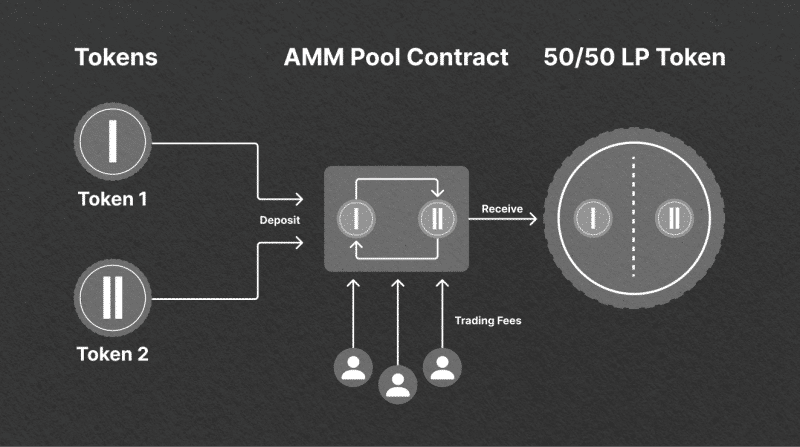
Automated market makers, or AMMs, let users trade digital assets through smart-contract-based liquidity pools instead of traditional order books. When AI evaluates an AMM, it is not simply asking whether the pool has a high annual percentage yield. It is combining market data, pool mechanics, liquidity distribution, trading activity, fees, execution quality, and technical risk to estimate how the protocol behaves under different conditions.
The most useful evaluation separates two questions:
- How well does the AMM serve traders?
- How attractive and risky is it for liquidity providers?
Those questions overlap, but they are not identical. A pool can offer low slippage to traders while exposing liquidity providers to significant price divergence, or it can display high fees while having insufficient volume to justify its risks.
What an AMM does
An AMM uses a mathematical pricing rule and pooled liquidity to facilitate trades. Instead of matching each buyer with a seller, the protocol allows traders to exchange assets against reserves supplied by liquidity providers.
The pricing rule depends on the AMM design. A constant-product pool, for example, adjusts the relative price of two assets as one reserve increases and the other decreases. Other designs are optimized for stable assets, correlated assets, weighted portfolios, or concentrated liquidity.
AI must therefore identify the pool type before comparing performance. A stable-asset pool should not be judged by the same criteria as a volatile token pair. The expected price movement, fee structure, rebalancing behavior, and liquidity requirements can differ substantially.
The evaluation also needs to account for the protocol version. In Uniswap v3 and v4, liquidity providers can select a custom price range rather than distributing capital across the entire possible price curve. Uniswap’s documentation explains that concentrated liquidity can improve capital efficiency but requires more active management.
The data AI examines
An AI system evaluating an AMM usually begins with historical and current blockchain data. The quality of its conclusions depends heavily on whether the data is complete, correctly labeled, and organized by pool and time period.
Important inputs include:
- Pool reserves and total value locked
- Token prices and price volatility
- Trading volume by time interval
- Swap fees collected
- Number and size of transactions
- Liquidity positions and their price ranges
- Deposits and withdrawals
- Pool fee tier
- Gas costs and transaction failures
- Oracle observations and reference prices
- Smart-contract addresses and deployment history
- Governance changes and emergency actions
Total value locked, commonly called TVL, measures the value deposited in a protocol or pool at a given time. It is useful, but it is not the same as usable liquidity. In a concentrated-liquidity pool, much of the reported TVL may sit outside the current trading range and contribute little to immediate execution.
That distinction is central to AI-based evaluation. A model that looks only at TVL may conclude that a pool is deep when the active price range is actually thin.
How AI evaluates liquidity depth
Liquidity depth describes how much a trader can buy or sell before the execution price moves materially. AI can estimate depth by examining the liquidity available around the current price and simulating trades of different sizes.
For a traditional full-range pool, reserve balances may provide a useful first approximation. For a concentrated-liquidity pool, the model must inspect liquidity across price ticks and ranges. Uniswap describes ticks as discrete price boundaries used to implement custom liquidity positions. The Uniswap v3 whitepaper describes liquidity as bounded within selected price ranges and organized through discrete ticks.
A practical model may simulate:
- A small trade relative to the pool
- A medium trade during normal conditions
- A large trade during a volatile period
- A trade that crosses several liquidity ranges
- A transaction executed after a sudden price move
The output can include estimated price impact, expected slippage, and the amount of active liquidity available near the trade price.
AI should also distinguish between displayed liquidity and executable liquidity. A large position outside the current range may become useful later, but it does not necessarily protect a trader today.
How AI measures slippage and execution quality
Slippage is the difference between the expected execution price and the actual execution price. It can result from the trade itself, changing pool conditions, transaction ordering, network congestion, or an outdated quote.
AI can evaluate execution quality by comparing:
- The quoted price before a swap
- The final execution price
- The reference market price at execution
- The pool’s liquidity and volume at that moment
- The transaction’s gas cost and confirmation delay
This allows the model to separate ordinary price impact from other causes of poor execution. A large swap in a shallow pool may create predictable price impact. A smaller swap that executes far from the reference market may indicate stale routing, adverse ordering, or temporary imbalance.
A strong evaluation uses distributions rather than one average number. Median slippage may look acceptable while the worst five percent of trades create substantial losses. AI can identify these tail outcomes by grouping swaps by size, time, volatility, and market condition.
How AI assesses liquidity-provider returns
Liquidity-provider returns come primarily from swap fees, but gross fees are not the same as net performance. A useful estimate considers:
- Fees earned
- Change in the value of deposited assets
- Impermanent loss
- Gas and transaction costs
- Rebalancing costs
- Withdrawal fees, where applicable
- Smart-contract and bridge risks
- Opportunity cost of using the capital elsewhere
Impermanent loss is the difference between the value of providing assets to a pool and simply holding those assets, assuming the comparison uses the same initial deposit and market prices. The loss is not always permanent in the practical sense; it can shrink if prices return, and fees may offset it. However, a liquidity provider can still withdraw fewer assets or less value than a passive holding strategy during a particular period.
AI can estimate this exposure by reconstructing a position through time. For a concentrated position, it must also determine when the position was active. A position outside its selected range may stop earning swap fees and may become composed primarily of one asset.
The model should report a range of outcomes instead of presenting one projected yield as a certainty. Historical fee income does not guarantee future returns, particularly when volume, volatility, competition, or token prices change.
The main evaluation dimensions
| Evaluation area | What AI measures | Why it matters | Main limitation |
|---|---|---|---|
| Liquidity depth | Active liquidity near the current price and simulated price impact | Indicates likely trader execution quality | Depth can change quickly |
| Fee efficiency | Fees relative to active liquidity and capital exposure | Helps compare earning potential | Historical fees may not persist |
| LP risk | Price divergence, range inactivity, and asset composition | Shows risks beyond headline yield | Models depend on price assumptions |
| Pool resilience | Behavior during volatility, large trades, and withdrawals | Reveals stress performance | Rare events are difficult to model |
| Technical safety | Contract history, permissions, upgrades, and incidents | Addresses protocol-level risk | Code analysis cannot remove all unknowns |
How AI evaluates price risk
Price risk enters an AMM evaluation in several ways. The underlying tokens may be volatile, correlated, illiquid, or exposed to a common market shock. A pool containing two assets that usually move together may behave differently from a pool pairing a volatile token with a stablecoin.
AI can calculate historical volatility, correlations, drawdowns, and the frequency of large price gaps. It can then test hypothetical conditions such as:
- One token falls sharply while the other remains stable
- Both tokens decline during a broad market sell-off
- A stablecoin temporarily loses its intended price reference
- Trading volume disappears while withdrawals increase
- The market moves outside most concentrated-liquidity ranges
These scenarios are not forecasts. They are stress tests designed to reveal how the pool might behave if selected conditions occur.
The model must also question the price data itself. A thinly traded token may have an unreliable market price, while a manipulated or faulty oracle can distort valuation. AI should compare multiple reference sources where possible and flag periods in which pool prices diverge sharply from external markets.
How AI evaluates oracle and manipulation risk
Many DeFi systems use or reference oracle prices, which are external or protocol-derived measurements of asset prices. AI can compare oracle observations with pool prices, centralized exchange data, decentralized exchange data, and time-weighted averages when those sources are available.
A time-weighted average price uses observations over a period rather than relying on one instantaneous transaction. Uniswap documentation identifies a built-in time-weighted price oracle among the features associated with its v3 system. The official developer material describes the oracle as part of the protocol’s available features.
An AI review can flag:
- Sudden price changes caused by a single large swap
- Low-volume pools with unusually large price movements
- Divergence between a pool and broader market references
- Thin liquidity near an oracle observation point
- Repeated transactions that appear designed to influence a price
- Short observation windows vulnerable to temporary distortion
Detection is not proof of manipulation. A legitimate rebalance, listing, liquidation, or market event can also produce unusual activity. Human review and transaction-level investigation remain necessary for high-stakes conclusions.
How AI evaluates smart-contract and governance risk
Financial metrics do not reveal whether the underlying contracts are secure. An AMM evaluation should also inspect the technical and administrative structure around the pool.
Relevant questions include:
- Is the contract verified and publicly documented?
- Has it been audited, and what did the audit cover?
- Can an administrator pause, upgrade, or redirect funds?
- Are upgrade keys controlled by a multisignature wallet or another mechanism?
- Has the code changed since an audit?
- Does the pool rely on external tokens, bridges, or oracles?
- Have prior incidents been disclosed?
- Can governance change fees or critical parameters?
An AI system can classify contract permissions, compare deployed bytecode with published code, scan transaction history, and summarize governance proposals. It should not present an automated scan as a security guarantee. Audits also reduce uncertainty rather than eliminate it, and a secure AMM contract can still interact with a compromised token, bridge, oracle, or front-end.
A practical AI evaluation workflow
A repeatable process is more useful than a single score.
1. Identify the pool
Record the chain, contract address, token pair, AMM design, fee tier, deployment version, and whether liquidity is full-range or concentrated.
2. Validate the data
Check token decimals, price sources, reserve readings, transaction timestamps, and possible duplicate or missing records. Incorrect labels can invalidate an otherwise sophisticated model.
3. Reconstruct liquidity
Map liquidity across price ranges and identify how much is active near the current price. This step is especially important for concentrated-liquidity pools.
4. Simulate trades
Test multiple trade sizes under normal and stressed conditions. Include gas, fee tier, price impact, and likely execution delay where the data supports those estimates.
5. Estimate LP outcomes
Compare fee income with price divergence, inactive-range periods, rebalancing, gas, and asset-price changes. Report historical observations separately from forward-looking scenarios.
6. Stress-test the pool
Model sharp price movements, volume declines, liquidity withdrawals, oracle divergence, and correlated asset losses.
7. Inspect the technical perimeter
Review contracts, permissions, upgrades, oracle dependencies, governance, audits, and known disclosures.
8. Explain uncertainty
Show the assumptions, date range, missing data, confidence limitations, and conditions that could make the conclusion wrong.
Common mistakes in AI-based AMM analysis
The first mistake is treating TVL as a complete measure of liquidity. In concentrated pools, active liquidity can be far smaller than total deposited value.
The second is ranking pools by annualized fees without accounting for volatility and price divergence. A high fee rate may compensate providers for substantial risk rather than represent easy income.
The third is using averages that hide adverse outcomes. A model should show how execution and returns vary across trade sizes, market regimes, and time periods.
The fourth is trusting a single oracle or price feed. Cross-checking is necessary when prices determine valuations, liquidations, or risk scores.
The fifth is confusing anomaly detection with proof. AI can identify patterns worth investigating, but it may misclassify ordinary market activity as malicious behavior.
The sixth is ignoring data leakage. If a model uses information that was unavailable at the time of a historical decision, its backtest may look stronger than a real deployment would have been.
How to interpret an AI-generated AMM score
An AI score should be treated as a structured summary, not a verdict. Before relying on it, ask:
- What period does the score cover?
- Which pool version and chain were analyzed?
- Does it measure active liquidity or only TVL?
- Are fees gross or net of estimated costs?
- How are impermanent loss and range inactivity handled?
- Which stress scenarios were included?
- What data was missing?
- Can the result be reproduced from documented inputs?
- Does the score reflect trader execution, LP returns, technical safety, or all three?
A high score may indicate strong historical execution and resilient liquidity, but it does not remove smart-contract, market, oracle, governance, or counterparty risks. A low score may reflect temporary volume loss or a narrow observation window rather than permanent weakness.
Conclusion
How AI evaluates automated market makers depends on whether it analyzes the pool as a trading venue, an investment opportunity, or a technical system. The strongest approach combines all three perspectives.
For traders, the key evidence is active liquidity, expected price impact, slippage distribution, execution reliability, and oracle quality. For liquidity providers, the analysis must include fees, price divergence, range activity, rebalancing costs, and asset risk. For everyone, contract permissions, dependencies, governance, and stress behavior matter.
The central lesson is simple: AI should evaluate an AMM through mechanisms and scenarios, not headline APY or TVL alone. A useful assessment explains where liquidity is available, how the pool behaves when conditions change, what risks drive the result, and which assumptions remain uncertain.
You may also like
- Best AI-Powered Helpdesk Software for Startups in 2025: Top Picks and Features
- Hidden Costs of Building an AI SaaS Startup: The Real 2026 Budget Breakdown
- AI Trading Software: Key Features, Costs, and Limitations
- AI in Wealth Management: The Growing Role of Digital Assets in 2026
- Apple Watch Ultra 3 Satellite Connectivity: The Future of Off-Grid Communication