

- Published on
AI for Decentralized Lending Portfolio Management: A Practical Risk Guide
Listen to the full article:
- Authors

- Name
- Jagadish V Gaikwad

Decentralized lending portfolio management is the process of choosing, monitoring, and adjusting lending positions across blockchain protocols. AI for decentralized lending portfolio management can make that work more systematic by analyzing on-chain data, detecting deteriorating positions, comparing risks, and recommending actions.
AI does not remove smart-contract, oracle, liquidity, market, or governance risk. It also should not be treated as an autonomous guarantee against losses. Its most useful role is as a decision-support layer connected to reliable blockchain data, explicit risk limits, and human approval for consequential transactions.
A practical system should answer five questions:
- Which assets and protocols are being used?
- How much collateral and debt are exposed to each risk?
- How close is each position to liquidation?
- What could happen under plausible price, interest-rate, or liquidity shocks?
- Which action improves resilience after fees, slippage, and execution risk?
What decentralized lending portfolio management involves
Decentralized lending protocols allow users to supply assets, earn variable returns, and borrow against collateral through smart contracts. Unlike a traditional bank account, the position is governed by code, market prices, protocol parameters, and wallet permissions.
A portfolio may contain several different exposures:
- Supplied stablecoins earning variable interest
- Volatile assets used as collateral
- Borrowed stablecoins or other tokens
- Liquidity positions that can be withdrawn or unwound
- Positions distributed across multiple chains and protocols
- Governance or staking tokens with separate market risks
The central risk is not simply whether an asset has a high advertised yield. It is whether the portfolio can remain solvent and liquid when conditions change.
Aave, one of the major lending protocols, represents borrower safety through a health factor. The value of collateral, liquidation thresholds, debt, oracle prices, and accrued interest all affect that measure. A position becomes eligible for liquidation when its health factor falls below one, according to Aave’s V3 documentation.
That makes portfolio management a continuous monitoring problem. A position that appears comfortable today can become vulnerable if collateral falls, debt grows through variable interest, an oracle updates sharply, or liquidity disappears.
Where AI can help
AI is most valuable when it converts large amounts of changing data into prioritised decisions. It can support, rather than replace, deterministic risk controls.
1. Portfolio discovery and classification
The first challenge is knowing what a wallet actually owns or owes. A portfolio manager can use blockchain indexing and transaction-history analysis to classify:
- Supplied assets
- Borrowed assets
- Collateral assets
- Available liquidity
- Protocol and chain exposure
- Approval and contract permissions
- Pending or recently changed positions
Machine-learning models can help classify unfamiliar transaction patterns, identify repeated protocol interactions, and group wallets or positions into useful categories. However, classification should remain explainable. A system should show the transaction, contract, token, and balance that led to its conclusion rather than presenting an unexplained label.
This matters because token symbols and contract addresses can be confusing. Wrapped assets, bridged assets, interest-bearing receipt tokens, and similar names may represent different legal, technical, and liquidity risks.
2. Health-factor and liquidation monitoring
AI can watch the inputs that affect liquidation risk and rank positions by urgency. A useful dashboard might combine:
- Current health factor
- Distance from the liquidation threshold
- Collateral concentration
- Debt denomination
- Price-feed freshness
- Borrow-rate movement
- Available repayment liquidity
- Estimated liquidation costs
Aave documents liquidation thresholds and other reserve-level parameters, while its risk framework also includes supply caps, borrow caps, isolation mode, and siloed assets. These controls limit exposure to selected assets and can reduce certain forms of protocol risk, as described in the Aave risk framework.
AI can identify a pattern such as “the account is becoming more vulnerable because collateral is concentrated in one volatile asset and the debt rate is rising.” The actual liquidation rule should still come from protocol data and deterministic calculations, not from a language model’s guess.
3. Scenario analysis
Historical volatility alone does not describe every possible failure. A risk engine can model scenarios such as:
- A collateral price decline
- A debt asset appreciating against collateral
- A rapid increase in variable borrow rates
- A stablecoin losing its intended price level
- A chain becoming congested
- A bridge or market becoming temporarily illiquid
- A price oracle becoming delayed or unavailable
AI models can help select relevant scenarios, detect unusual correlations, or estimate which positions are most sensitive. They can also compare the effects of repaying debt, adding collateral, reducing leverage, or moving part of the portfolio.
The output should be expressed as a range of possible outcomes, not as a certain prediction. A model trained on calm market conditions may underestimate sudden price gaps, liquidity failures, or correlated losses.
4. Yield and risk comparison
A high supply rate may attract capital, but the rate can change as utilization changes. It may also be accompanied by smart-contract, asset, oracle, chain, or liquidity risk.
AI can help compare opportunities using a broader scorecard:
- Gross supply yield
- Borrow cost
- Expected transaction fees
- Slippage during entry or exit
- Contract and protocol exposure
- Oracle dependence
- Asset volatility
- Liquidity depth
- Concentration limits
- Exit time during network congestion
The relevant result is not the displayed rate. It is the estimated net outcome after fees, borrowing costs, expected losses, and execution constraints.
Any model should preserve the distinction between verified protocol data and estimates. A displayed yield is an observable current or recent value; expected loss, stress performance, and future rates are model outputs.
5. Rebalancing recommendations
A portfolio manager can define rules such as:
- Keep the health factor above a chosen internal buffer
- Limit exposure to one collateral asset
- Cap debt in assets with rapidly changing borrowing rates
- Maintain enough liquid assets for emergency repayment
- Avoid relying on a single chain or bridge
- Reduce positions when oracle or liquidity conditions deteriorate
AI can then rank possible adjustments. For example, it might compare repaying debt, supplying more collateral, withdrawing a portion of an exposed asset, or moving liquidity to another venue.
Every recommendation should include its trade-offs. Repaying debt may improve liquidation safety but reduce available capital. Adding collateral may reduce leverage but increase concentration. Moving to another protocol may lower one risk while introducing a new contract, oracle, governance, or bridge dependency.
6. Governance and parameter monitoring
Protocol settings can change through governance or authorised risk managers. A portfolio tool can monitor changes to:
- Loan-to-value limits
- Liquidation thresholds
- Liquidation bonuses
- Supply and borrow caps
- Reserve activation status
- Interest-rate model parameters
- Oracle configuration
- Isolation or silo rules
These changes can alter the safety of an existing position without any action from the wallet owner. A governance-monitoring model can summarise proposals, compare parameter changes, and flag portfolios affected by them. The underlying proposal and on-chain execution should remain the source of truth.
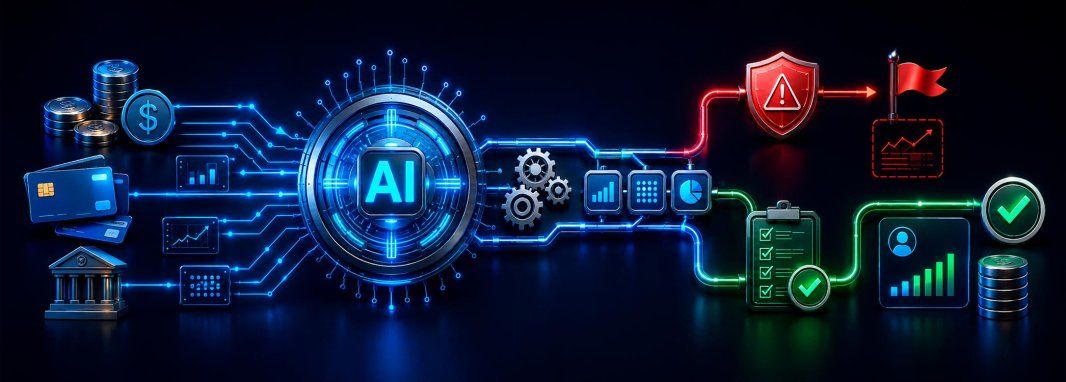
A useful architecture for AI-assisted management
A robust system separates data collection, analysis, recommendation, and execution.
Data layer
The data layer should collect on-chain balances, protocol reserve parameters, interest rates, oracle values, transaction costs, and liquidity information. It should preserve block numbers and timestamps so users can determine whether a value is current, delayed, or historical.
Deterministic risk layer
This layer calculates facts such as collateral value, debt value, health factor, concentration, and distance to internal risk limits. Deterministic calculations are preferable for safety-critical values because they can be tested and reproduced.
AI analysis layer
The AI layer can detect unusual movements, prioritise alerts, cluster related exposures, summarise governance proposals, and generate scenario comparisons. It should cite the data used for each conclusion and identify uncertainty.
Policy layer
The policy layer translates preferences into limits. Examples include a minimum health-factor buffer, a maximum allocation to one collateral asset, and a requirement for human approval before signing transactions.
Execution layer
The execution layer should be deliberately constrained. It may prepare a transaction for review rather than signing automatically. If automated execution is permitted, it should use limited permissions, transaction-size caps, slippage limits, simulation, and an emergency pause.
A natural-language model should never receive unrestricted authority over a wallet merely because it can explain a portfolio clearly.
Comparing management approaches
| Approach | Best use | Main advantage | Main limitation |
|---|---|---|---|
| Manual monitoring | Small portfolios and infrequent changes | Direct control and low automation complexity | Easy to miss fast-moving liquidation risk |
| Rule-based automation | Clear, repeatable risk limits | Transparent and testable actions | Does not adapt well to unfamiliar conditions |
| AI-assisted analysis | Large, multi-protocol portfolios | Finds patterns and prioritises attention | Can produce incorrect or poorly calibrated recommendations |
| Fully autonomous execution | Narrow strategies with strong controls | Fast response to defined events | Adds key-management, model, contract, and execution risk |
The strongest general approach is usually a layered combination: deterministic calculations for limits, AI for analysis and prioritisation, and human approval for unusual or high-value actions.
The risks AI cannot solve
AI does not neutralise smart-contract risk. A protocol can contain a vulnerability, an upgrade can change behaviour, or an integration can fail. A polished dashboard may simply make a dangerous position easier to understand.
Oracle risk also remains material. Aave explains that lending systems depend on external price and redemption-ratio data and that an oracle failure or compromise can produce incorrect valuations. Its documentation describes decentralised oracle mechanisms such as Chainlink as a mitigation, not an absolute elimination of risk. See Aave’s risk documentation.
Liquidity risk is another limitation. A model may identify a liquidation opportunity, but the required asset may not be available at the expected price. Network congestion can delay repayment or collateral adjustments. Slippage can turn a theoretically profitable rebalance into a loss.
Model risk deserves separate treatment. A model may:
- Learn from incomplete or biased historical data
- Treat correlated assets as independent
- Miss regime changes
- Overreact to noisy price movements
- Confuse a protocol label with a verified safety assessment
- Generate persuasive explanations for an incorrect conclusion
Security risk also increases when AI systems can read wallet data, handle private information, or initiate transactions. Prompt injection through untrusted protocol text, compromised data feeds, malicious token metadata, and unsafe tool permissions can affect an AI-enabled workflow.

A practical implementation checklist
Before using AI to manage a decentralized lending portfolio, establish the following controls:
- Use verified contract addresses and reliable indexing sources.
- Record chain, block, timestamp, token contract, and data origin for important values.
- Recalculate health and liquidation metrics independently of the language model.
- Set internal buffers above protocol liquidation thresholds.
- Stress-test collateral, debt, interest-rate, and liquidity changes.
- Track oracle freshness and fallback behaviour.
- Include gas, slippage, bridge costs, and failed-transaction risk in recommendations.
- Separate read-only analysis from transaction signing.
- Require simulation and human review for high-value actions.
- Restrict automated permissions and define an emergency stop.
- Log recommendations, inputs, approvals, and executed transactions.
- Test the system against historical volatility and synthetic extreme scenarios.
- Review model performance after false alarms and missed alerts.
- Treat governance changes as portfolio events, not background noise.
A simple alert is often more useful than an ambitious autonomous agent. For example, an alert can state that a position would fall below its internal safety buffer if collateral declined by a specified percentage, then show the repayment or collateral options available at current prices.
How to evaluate an AI portfolio tool
Evaluate the tool on evidence, not presentation.
Ask whether it:
- Shows the raw positions behind its conclusions
- Identifies data age and source
- Distinguishes facts from forecasts
- Explains assumptions in scenario analysis
- Reproduces key calculations
- Covers every relevant chain and protocol
- Accounts for transaction costs and liquidity
- Supports read-only mode
- Simulates transactions before execution
- Provides clear permission and custody controls
- Records an audit trail
- Handles missing or conflicting data safely
Avoid tools that advertise guaranteed yield, liquidation-proof strategies, or effortless autonomous profit. Those claims are inconsistent with the underlying risks of variable rates, collateral volatility, oracle dependence, liquidity constraints, and smart contracts.
Conclusion
AI for decentralized lending portfolio management is best understood as an information and control system, not a prediction machine. It can organise wallet data, monitor health factors, compare scenarios, detect unusual risk, summarise governance changes, and suggest rebalancing actions.
The safest design assigns different jobs to different components. Protocol data and deterministic calculations establish what is happening. AI helps interpret complexity and prioritise decisions. Explicit policies define acceptable risk. Human review and constrained execution protect the wallet from model errors and unexpected market conditions.
For most users, the goal should not be maximum automation. It should be faster awareness, clearer trade-offs, and disciplined action before a manageable position becomes a forced liquidation.

You may also like
- Intel Nova Lake CPU Architecture 2026: What to Expect from Intel’s Big Leap
- DeFi Risk Management With Artificial Intelligence: How to Stop Blindly Shipping on Chain
- How AI Is Changing Institutional Crypto Portfolio Management
- Best AI Writing Tools for Bloggers and YouTubers in 2025: Ultimate Guide to Boost Your Content Creation
- AI-Powered SaaS for Healthcare Data Analytics: Transforming Patient Care and Operations in 2025