

- Published on
AI-Powered Portfolio Management: How It Works in 2026
Listen to the full article:
- Authors

- Name
- Jagadish V Gaikwad
Your portfolio isn’t really “managed” until AI starts watching it every minute
Stop pretending portfolio management is just picking a few funds and hoping for the best. AI-powered portfolio management watches your data, scores your risk, builds an allocation, and keeps adjusting when markets move.
That’s the real shift. It’s not magic, and it’s definitely not a replacement for judgment. It’s a machine that can process more signals than a human team ever could, then turn that into faster decisions.
Look, here’s the basic flow
The annoying part is that most people overcomplicate this. The actual workflow is pretty clean: collect data, assess the investor, build a portfolio, monitor drift, rebalance, and keep learning from outcomes.
A typical AI-powered portfolio management system starts with a questionnaire or investor profile. It captures goals, time horizon, and risk tolerance, then maps those inputs to a target allocation across stocks, bonds, sectors, or regions.
After that, the system pulls in market data, account data, and often behavioral signals. Some systems also use news and text analysis to improve forecasts and identify risk earlier than traditional methods do.
Here’s what the AI is actually doing
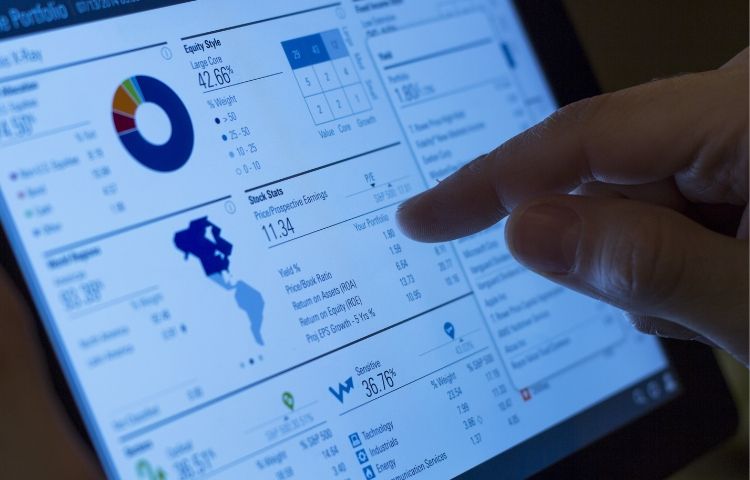
Real talk: the phrase “AI” gets abused a lot in finance. In practice, it usually means machine learning, predictive analytics, text analysis, and automation working together.
First, the models estimate expected returns, volatility, and correlations better than old-school rules alone, which helps with allocation decisions. Then they watch for changes in market conditions and portfolio drift, so they can flag trouble before a quarterly review would catch it.
That’s why AI-powered portfolio management feels more responsive than manual oversight. It isn’t waiting for the calendar. It’s reacting to fresh data as it arrives.
Why the data layer matters more than the model hype
Here’s the thing nobody wants to hear: bad data will wreck a smart model fast. If your inputs are messy, missing, or inconsistent, your output will be garbage with a fancy label on top.
That’s why serious systems start by cleaning and structuring data before any model gets involved. They bring together market feeds, account data, policy rules, and sometimes CRM or client information into one usable layer.
Once that foundation exists, the model can create features like volatility bands, sentiment scores, or moving averages. Those are the signals it uses to spot patterns that humans miss when they’re buried in dashboards and meetings.
The part everyone loves: personalization
Honestly? This is where AI-powered portfolio management gets interesting. Instead of dropping everyone into the same generic risk bucket, it can tailor the portfolio to the investor’s actual goal, time horizon, cash flow, and loss tolerance.
That matters because two people can say they “want growth” and mean wildly different things. One can handle a 20% drawdown without flinching. The other panics after a bad week and ruins the plan.
AI can also read behavioral signals, which is underrated. If cash flow patterns change or a user starts behaving like they’re about to pull money out, the system can adjust recommendations before the portfolio gets blown up by emotion.
Rebalancing is where the machine earns its keep
The trap most teams fall into is thinking allocation is the whole game. It isn’t. The real grind is keeping the portfolio on target after markets start doing their usual nonsense.
AI-powered rebalancing tracks drift continuously, not just on a monthly schedule. When holdings move too far from target weights, the system can sell what got oversized and buy what shrank, keeping risk closer to the original plan.
That sounds simple. It isn’t, because you’re balancing taxes, fees, turnover, and risk all at once. This is exactly why continuous monitoring beats occasional human check-ins.
Tax-loss harvesting is the sneaky win
Here’s what people overlook: AI doesn’t just chase returns. It can also look for tax-loss harvesting opportunities, which means selling losing positions to offset gains and reduce the tax bill.
That’s a boring phrase for a very real benefit. If you’re managing money at scale, those small tax improvements compound hard over time.
This is one of the reasons AI-powered portfolio management gets traction with robo-advisors and modern wealth platforms. It can execute repetitive tax and rebalancing tasks faster than a human team can manually chase them.
Comparison table: manual portfolio management vs AI-powered portfolio management
| Dimension | Manual approach | AI-powered approach |
|---|---|---|
| Speed | Slow. Reviews happen on a schedule. | Fast. Monitoring is continuous. |
| Personalization | Usually broad buckets and standard rules. | Built around user goals, risk, and behavior. |
| Risk detection | Often reactive. | Earlier warning signals from live data and text analysis. |
| Rebalancing | Done periodically, sometimes too late. | Triggered when drift crosses thresholds. |
| Catch | Great if you want control. Bad if you want scale. | Great if you want scale. Bad if your data is trash. |
Where AI helps most in real life
Look, this tech is not trying to replace every portfolio manager. It’s best at the stuff humans hate doing all day, every day: data cleanup, monitoring, signal detection, and repetitive execution.
It’s also useful when you need speed. If volatility spikes, news breaks, or correlations shift, AI can process the change much faster than a manual workflow can.
That’s why institutions use it for predictive risk management and performance analysis, while smaller platforms use it for personalization and automated rebalancing.
The hype is real, but so are the limits
Yeah, I know, every vendor says AI is going to “transform investing.” Most of that is marketing sludge. The truth is more annoying: AI works best when it sits on top of solid investment policy and human oversight.
Without governance, you get fast mistakes. Without explainability, you get model outputs nobody trusts. Without proper monitoring, you can build a system that looks smart right up until it takes a dumb trade.
The CFA Institute has been clear that AI can improve estimates and asset allocation, but it still needs to fit inside traditional portfolio frameworks and decision controls. That’s the sane view, and it’s the one that survives contact with reality.

What a good system actually includes
Here’s the thing: a real AI-powered portfolio management stack isn’t just one model. It’s a chain of pieces that work together.
It usually includes data ingestion, cleaning, feature generation, allocation logic, monitoring, execution, and feedback loops. If one of those layers is weak, the whole thing gets shaky fast.
You also need explainability. If the system recommends a rebalance, someone should be able to answer why it happened, what data drove it, and whether the move fits the mandate.
The workflow in plain English
Honestly? This is the easiest way to think about it. The system learns your objective, watches the market, decides when your portfolio is off track, and fixes the drift before it gets ugly.
A strong setup usually follows this pattern:
- Gather client and market data.
- Clean and structure the data.
- Score risk and estimate likely outcomes.
- Build the initial allocation.
- Watch portfolio drift and market changes.
- Rebalance or alert when thresholds are crossed.
- Learn from results and update future decisions.
That’s the whole loop. No mysticism. Just faster decision-making with a lot more data than a human can hold in their head at once.
Why humans still matter
Stop buying the fantasy that AI runs the show by itself. It doesn’t. Humans still set the investment rules, approve the risk bounds, and decide when the model is being clever versus reckless.
That matters even more in regulated or high-stakes environments. If the model starts chasing the wrong signal, someone has to catch it before the portfolio eats a bad week and the client gets a nasty surprise.
The best teams treat AI as an analyst that never sleeps, not a manager that gets a free pass. That mindset keeps you from turning automation into a liability.
When AI-powered portfolio management is worth it
Here’s the blunt answer: it’s worth it when you have lots of data, lots of repetitive decisions, and a real need to react faster.
If you’re a small investor who just wants a basic index portfolio, a simpler setup might be enough. If you’re managing many accounts, handling continuous inflows and outflows, or trying to improve risk control at scale, AI starts to make a lot more sense.
It’s also useful when you care about personalization. The more variation you have across users, the harder it gets to manage everything manually without dropping the ball.
The part nobody says out loud
Real talk: AI-powered portfolio management is only as smart as the rules around it. If your governance is weak, your results will be weak too.
That’s why the winning setup isn’t “AI instead of people.” It’s AI plus humans plus clear policy plus clean data. That combo is boring, disciplined, and way more profitable than chasing some shiny black-box promise.
If you’re building or buying this kind of system, focus on three things first: data quality, explainability, and monitoring. Get those wrong and the rest is just expensive noise.
AI-powered portfolio management works because it watches more, reacts faster, and keeps portfolios aligned with real goals instead of stale schedules. The question isn’t whether the tech works. It’s whether your team is disciplined enough to use it without turning speed into chaos.
What’s your bigger challenge right now: messy data, weak oversight, or a portfolio process that’s way too slow?
You may also like
- AI SaaS Platforms for Real-Time Business Insights: Unlocking Instant Data-Driven Decisions
- Cloud Hosting for AI-Generated Content Platforms: The Ultimate 2025 Guide
- AI-Native Startups Disrupting Traditional Enterprise Software Markets in 2026
- How Messi Can Lift the FIFA World Cup Once Again: Argentina’s 2026 Title Defense
- AI-powered SaaS for Team Collaboration: How to Build Smarter, Faster Teams