

- Published on
How AI Evaluates DeFi Protocol Health: Metrics, Models, and Limits
Listen to the full article:
- Authors

- Name
- Jagadish V Gaikwad
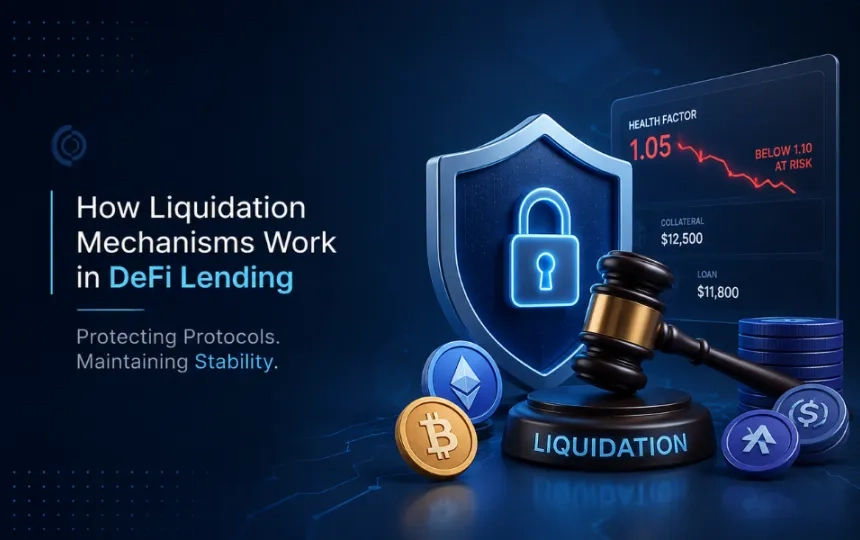
A healthy DeFi protocol is more than a project with a high total value locked (TVL) or an attractive annual percentage yield. Its condition depends on whether liquidity is real and resilient, collateral can absorb market stress, smart contracts behave as intended, governance remains trustworthy, and dependencies such as price oracles continue to work.
How AI evaluates DeFi protocol health is therefore best understood as a continuous risk-assessment process, not a single prediction. AI systems combine blockchain activity, market data, contract code, wallet behavior, and protocol documentation to identify patterns that may be difficult to detect manually. Research on machine-learning-based DeFi assessment describes applications including anomaly detection, fraud analysis, market-risk forecasting, and smart-contract evaluation.the research literature on machine learning for DeFi risk assessment
AI can improve monitoring speed and consistency, but it cannot prove that a protocol is safe. Models learn from available data, may miss novel attacks, and can produce false alarms. The most useful output is a transparent set of risk signals that supports human due diligence—not a magic safety score.
What “protocol health” means in DeFi
Protocol health describes the ability of a decentralized application to continue operating under normal conditions and reasonable stress. The relevant indicators differ by protocol type.
For a lending protocol, analysts examine collateral quality, utilization, liquidation activity, bad debt, reserve levels, and dependence on a small number of assets or borrowers. For a decentralized exchange, they focus on liquidity depth, trading volume quality, slippage, pool concentration, oracle inputs, and exposure to manipulation. A stablecoin system requires additional analysis of reserves, redemption mechanisms, collateral correlations, and peg behavior.
A useful AI evaluation usually combines five dimensions:
- Economic health: liquidity, leverage, solvency, collateral quality, and revenue.
- Market health: volatility, price impact, spreads, volume, and correlation between assets.
- Technical health: contract behavior, upgrade controls, permissions, exploits, and dependencies.
- Behavioral health: wallet concentration, unusual transfers, governance activity, and transaction anomalies.
- Operational health: oracle reliability, bridge exposure, admin-key risk, and changes to deployed contracts.
No single metric is sufficient. TVL can rise because of temporary incentives. High volume can come from wash trading. A large audit portfolio does not eliminate upgrade or governance risk. AI’s role is to connect these signals and examine how they change together.
The data AI systems collect
Most DeFi risk engines begin with structured blockchain data. This includes transactions, token transfers, contract calls, liquidity-pool balances, lending positions, liquidations, governance votes, and newly deployed contracts. The system may also index events emitted by smart contracts and follow assets across multiple chains.
Market data adds token prices, volatility, order-book conditions where available, trading volume, and correlations. Protocol documentation and governance proposals provide context that raw transactions cannot: for example, whether a parameter change was intentional or whether a new contract is part of an approved upgrade.
Some systems also use external information such as security disclosures, sanctions data, exploit addresses, and code repositories. These sources require careful provenance. A model that silently mixes verified on-chain facts with unverified social-media claims can create a misleading score.
The data is normally transformed into features—measurable inputs for a model. Examples include:
- The percentage of pool liquidity controlled by the largest providers.
- The share of borrowed value backed by one collateral asset.
- The speed and size of net outflows.
- The frequency of failed transactions or abnormal contract calls.
- The distance between an asset’s market price and its oracle price.
- The concentration of voting power among governance addresses.
- The age and change history of deployed contracts.
- The number and value of interactions associated with known malicious addresses.
Cross-chain analysis makes the problem harder. The same economic position may appear as separate activity on different networks, while bridges introduce additional custody and smart-contract dependencies.
How AI evaluates liquidity and solvency
Liquidity analysis asks whether users can enter or exit positions without causing severe price movement. AI models can monitor pool depth, trading activity, withdrawals, utilization, and slippage over time. They may compare current behavior with historical patterns and with similar pools.
For lending protocols, a model can examine the relationship between supplied assets, borrowed assets, collateral values, and liquidation thresholds. It may flag a market where utilization is rising rapidly while available liquidity is falling. It can also test hypothetical shocks: what happens if collateral falls 20%, an oracle pauses, or the largest borrower withdraws collateral?
These are scenario analyses, not guaranteed forecasts. A model can estimate how much collateral might become liquidatable under defined assumptions, but it cannot know exactly how markets will behave during a panic. Liquidation cascades may worsen prices, while arbitrageurs may restore them—or disappear when the network is congested.
AI also helps distinguish productive activity from superficial growth. Sudden TVL increases accompanied by short-lived incentives, circular transfers, or highly concentrated deposits deserve more scrutiny than broad growth from independent users. That conclusion still needs human interpretation because legitimate market-making can resemble suspicious activity.
How AI detects abnormal behavior
Anomaly detection looks for activity that differs from a baseline. The baseline might describe normal hourly transaction volume, typical wallet interactions, expected liquidity movements, or ordinary governance behavior.
A system can use unsupervised methods, such as clustering and outlier detection, when labeled attack data is limited. It can also use supervised models trained on known examples of fraud or malicious behavior. Research on multichain DeFi fraud detection has evaluated methods including random forests, support-vector machines, gradient boosting, and neural networks, using measures such as precision, recall, and F1 score.the multichain DeFi fraud-detection study
Possible alerts include:
- A wallet borrowing and moving assets through an unusual sequence of contracts.
- A sudden increase in flash-loan activity around a low-liquidity pool.
- Liquidity removal immediately before a price collapse.
- Governance proposals coordinated by newly funded addresses.
- A contract interacting with functions rarely used during normal operation.
- A sharp change in transfers associated with a protocol treasury.
An alert is not proof of wrongdoing. New protocol launches, migrations, market stress, and legitimate arbitrage can all create unusual patterns. A reliable monitoring system therefore shows the underlying transactions and explains why the activity was flagged.
How AI evaluates smart-contract and governance risk
Smart-contract analysis can combine static code inspection with observed behavior. Static analysis examines bytecode or source code for features associated with access-control failures, reentrancy risks, unsafe calls, upgrade mechanisms, and unusual token behavior. Dynamic analysis observes how deployed contracts behave during transactions and under simulated inputs.
Machine learning can classify code patterns or prioritize contracts for deeper review. One peer-reviewed study tested random-forest classifiers using opcode features to identify DeFi token contracts associated with securities-violation indicators; its result was a research classification performance, not proof that the model can determine legal status for every token.the published study on machine learning and DeFi token code
Governance analysis adds another layer. AI can measure voting concentration, delegate relationships, proposal timing, quorum behavior, and whether a small group can change critical parameters. It can also compare a proposal with previous code or parameter changes.
The central limitation is that code risk is contextual. A model may identify an upgradeable proxy, but the real question is who controls the upgrade authority, how it is secured, whether a timelock exists, and whether users can exit before a change takes effect. These facts cannot be inferred reliably from one code pattern alone.
Oracle, bridge, and dependency risk
A protocol may have well-written core contracts and still fail because an external dependency fails. Oracles provide prices; bridges transfer assets between networks; automated keepers execute liquidations or maintenance operations; RPC providers and infrastructure support transaction access.
AI can compare prices from multiple sources, monitor update frequency, detect stale data, and identify large deviations between oracle feeds and observable markets. It can also trace whether a protocol is increasingly dependent on one bridge, one stablecoin, or one lending market.
This matters because correlated exposures can remain hidden in separate balance sheets. A protocol may appear diversified while much of its collateral ultimately depends on the same underlying asset or bridge. Feature engineering and graph analysis can reveal these connections.
However, oracle-quality judgments require knowledge of feed design, fallback logic, heartbeat intervals, and failure handling. A model that sees a temporary price difference cannot determine whether it reflects an attack, normal market fragmentation, or a legitimate update delay without protocol-specific context.
A practical AI health-assessment workflow
A transparent evaluation can follow this sequence:
- Define the protocol’s failure modes. Lending, trading, derivatives, and stablecoin systems require different risk features.
- Map the dependency graph. Identify contracts, tokens, oracles, bridges, upgrade authorities, keepers, and major external markets.
- Collect time-series data. Track liquidity, utilization, collateral, prices, transactions, governance, and contract changes rather than taking one snapshot.
- Create interpretable features. Prefer measurements that a reviewer can reproduce, such as concentration, net flows, oracle deviation, and liquidation exposure.
- Run complementary models. Use anomaly detection for unknown patterns, supervised classification for known behaviors, and scenario analysis for stress testing.
- Validate against historical events. Test whether alerts would have appeared before documented incidents, while recognizing that backtests can overstate performance.
- Present evidence with uncertainty. Show the transactions, assumptions, confidence level, and possible benign explanations.
- Escalate high-impact alerts. Human reviewers should inspect contract code, governance authority, market conditions, and incident context before action.
This process avoids treating a black-box score as an investment decision. It also makes model failure easier to diagnose.
AI signal versus underlying risk
| Evaluation area | Useful AI signal | What it can miss |
|---|---|---|
| Liquidity | Rapid outflows, falling depth, rising slippage | Off-chain liquidity, coordinated withdrawals, or sudden market closure |
| Lending solvency | Concentrated collateral, high utilization, liquidation clusters | Hidden correlated exposure and borrower agreements outside the chain |
| Smart contracts | Unusual code patterns, privileged functions, abnormal calls | Logic flaws that resemble normal code or vulnerabilities in dependencies |
| Oracles | Stale updates, price deviation, feed disagreement | Legitimate market fragmentation and undocumented fallback behavior |
| Governance | Voting concentration, unusual proposal coordination | Private coordination, legal control, or compromised signing devices |
| User behavior | New transaction paths, address clustering, fund movement | False positives from arbitrage, migrations, and legitimate automation |
The table illustrates why “health” should be reported as a profile of risks. A protocol can have healthy liquidity but dangerous upgrade authority, or strong governance controls but fragile oracle dependencies.

What AI cannot reliably determine
AI does not eliminate the need for audits, formal verification, economic modeling, or incident response. Its conclusions are constrained by the data and labels available to it.
The first limitation is novelty. An attack that differs from historical examples may evade a supervised model. Unsupervised systems may detect that something is unusual without identifying the exploit or its consequences.
The second is adversarial behavior. Attackers can split transactions, mimic normal users, manipulate training data, or exploit gaps between chains. A model that becomes a target can degrade precisely when it is most needed.
The third is measurement quality. On-chain activity is transparent but not automatically meaningful. One person may control many addresses, and many addresses may represent one service. Bot activity can inflate transaction counts, while incentive programs can distort volume and TVL.
The fourth is false precision. A score such as 82 out of 100 may look objective even when its weighting reflects undocumented assumptions. Readers should ask which risks the score includes, how recent the data is, how the model was validated, and whether the output is calibrated.
Finally, AI cannot guarantee future solvency or safety. It can identify conditions associated with risk and test defined scenarios. It cannot predict every governance decision, market shock, oracle failure, or contract bug.
How to read an AI-generated DeFi health score
Before relying on a dashboard or report, check:
- Data coverage: Which chains, contracts, tokens, and time periods are included?
- Update frequency: Is the score live, hourly, daily, or based on an old snapshot?
- Method transparency: Are the features, weights, model type, and validation results explained?
- Evidence links: Can each alert be traced to transactions, code, governance records, or market data?
- Protocol specificity: Does the model understand the protocol’s architecture and dependencies?
- Uncertainty: Does it distinguish confirmed facts from predictions and heuristic warnings?
- Conflict controls: Is the provider financially connected to the protocol being assessed?
- Human review: Are severe alerts investigated by security or risk specialists?
A useful report should make it possible to disagree with the conclusion. If users cannot inspect the signals behind a score, the number is a marketing label rather than a robust risk tool.
Conclusion
AI evaluates DeFi protocol health by combining on-chain behavior, liquidity and solvency metrics, smart-contract features, governance patterns, oracle data, and dependency mapping. Machine-learning models can detect anomalies, prioritize code review, identify suspicious activity, and run stress scenarios across large datasets.
The strongest approach is layered: use models to monitor continuously, transparent metrics to explain the result, and human review to interpret protocol-specific context. Health is not the same as TVL, yield, audit count, or an attractive dashboard score. It is the protocol’s ability to withstand technical, market, governance, and dependency failures—and the quality of evidence available for judging that ability.
You may also like
- How Financial Institutions Use AI for Crypto Market Analysis
- Google Pixel 10 Users Report Screen Glitch: The Colorful Snow Phenomenon Explained
- Ubisoft
- Why Businesses Are Adopting AI Orchestration Platforms in 2026: The Strategic Shift
- Argentina Destroys Switzerland 3-1 in 2026 FIFA World Cup Quarterfinals