

- Published on
How to Backtest an AI Trading Strategy Before Risking Money
Listen to the full article:
- Authors

- Name
- Jagadish V Gaikwad

Stop guessing and start proving it
Your AI trading strategy isn’t special until it survives a backtest. Most people skip the hard part, get seduced by a pretty equity curve, and then donate money to the market like it’s a subscription fee.
Real talk: backtesting an AI trading strategy is not about finding the highest return. It’s about finding out where the thing breaks before your wallet does.
First, write the strategy like a human
Look, the biggest mistake is letting the model be vague. If you can’t explain the setup in plain English, you’re not backtesting a strategy, you’re vibing with random code.
Start with one instrument, one timeframe, one entry trigger, one exit rule, and one invalidation rule. That keeps the test honest and makes it way harder for the AI to quietly cheat.
You also need to define the full rule set before the first test. If you keep changing the rules midstream, you’re not validating anything.
Clean data or garbage results
Here’s the thing: bad data makes smart people look stupid. If your historical feed is messy, missing candles, or full of survivorship bias, your backtest is fiction with charts.
Use clean OHLCV data and, if your strategy cares about it, add volume and sentiment feeds too. The key is coverage across multiple regimes, not just one lucky bull run.
That means you want calm markets, panic markets, and sideways chop. If your AI only looks good in one market mood, it’s probably not an edge.
Don’t let the AI peek into the future
Honestly? This is where people mess up hardest. Look-ahead bias will wreck your whole process if you let the model see data it shouldn’t have.
If you’re using higher timeframe data, confirmed bars only matter. On TradingView, that means using safe higher timeframe reads and closed-bar logic so the system isn’t reacting to incomplete information.
The same goes for execution logic. Trigger signals on bar close or confirmed states, not on whatever looked true mid-candle before reality finished happening.
Walk-forward testing is the grown-up move
Stop pretending a single backtest is enough. It isn’t. A strategy that wins on one window and dies everywhere else is just curve-fitting with a nice haircut.
Walk-forward testing splits the data into rolling train and test windows, then runs the system unchanged on the next segment. You repeat that across multiple periods and compare stability, not just total profit.
That’s the point. You want to know if the AI has real structure or if it only memorized one weird market phase.
What to actually test, not just admire
The annoying part is that most people obsess over net profit and ignore the ugly stuff. That’s how they end up with strategies that look brilliant until slippage shows up and eats the whole edge.
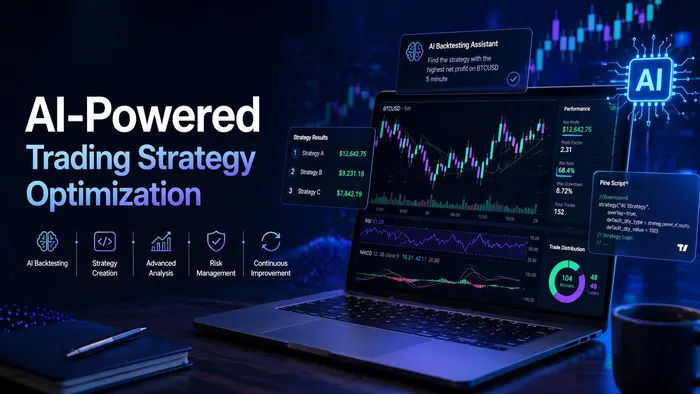
Track win rate, drawdown, profit factor, and accuracy, but don’t stop there. Also look at trade distribution by regime, because a strategy that only works in one market type is fragile by design.
You should also include slippage and commission in every serious test. If your backtest assumes free fills, you’re not testing reality.
Build a backtest process you can repeat
Look, you don’t need a giant research lab for this. You need a repeatable workflow that doesn’t change every time you get bored.
A solid process looks like this:
- Pick one asset and one timeframe pair.
- Write the strategy rules in plain language.
- Translate the rules into testable code or platform logic.
- Run the backtest with realistic costs.
- Export the trades and inspect the losers.
- Repeat on out-of-sample data and other instruments.
That’s boring. Good. Boring is how you stop blowing up.
Comparison table: quick-and-dirty vs serious backtesting
| Approach | What it feels like | What usually happens | Real Talk |
|---|---|---|---|
| Quick-and-dirty | “This strategy prints money.” | You overfit to one market stretch and get wrecked live. | Fast, but basically self-deception. |
| Serious backtest | “This is taking forever.” | You catch fake edge, bad fills, and weak regimes before going live. | Slower, but it’s the only version worth trusting. |
| Walk-forward testing | “Now I’m annoyed.” | You learn whether the strategy survives new periods without changing rules. | This is the one I’d trust most. |
Use AI for the right part of the job
Here’s the thing nobody says out loud: AI is great at helping you analyze, but terrible at being your blind faith machine. Don’t ask it to bless your strategy. Ask it to attack it.
One smart move is to feed the backtest report back into an AI and tell it to find the weakest assumption, the ugliest regime, and the trade you’d hate to explain to an investor. That’s way more useful than “is this good?”
You can also use AI to help translate plain-English rules into Pine Script or Python, then sanity-check the output manually. That saves time without handing over your brain.
The metrics that actually matter
Real talk: if you only care about total return, you’re asking to get fooled. A strategy can look amazing on paper and still be untradeable in the real world.
Focus on these:
- Drawdown: how bad the pain gets when the strategy is wrong.
- Profit factor: whether winners actually beat losers by a useful margin.
- Trade count: whether you have enough samples to trust the result.
- Regime performance: where the system wins and where it faceplants.
- Execution costs: what happens after slippage and commission.
If you’ve got fewer than around 100 trades, be cautious about claiming anything strong from the result. Small samples are where traders fall in love with lies.
How to read the ugly trades
Here’s what nobody talks about: the losers tell you more than the winners. If your system keeps failing in the same market condition, that’s not noise. That’s a clue.
Tag each trade by setup type and regime, then review where the system breaks. If the damage clusters around high-volatility news spikes or dead chop, you’ve learned something real.
That’s also where AI can help again. Let it summarize the failure patterns, but don’t let it rewrite the strategy just because it sounds clever.
Don’t test one toy version and call it research
The trap most teams fall into is testing one perfect setup and calling it done. That’s not research. That’s a demo.
You should stress-test across multiple instruments and timeframes to see whether the edge is portable. If it only works on one coin, one stock, or one candle size, you’ve probably built a coincidence.
Also, change one variable at a time. If you tweak the stop, the filter, and the exit all at once, you won’t know what actually mattered.
A practical example of sane backtesting
Imagine you build an AI strategy for BTC on the 1-hour chart. You define a trend filter, an entry trigger, a stop-loss, and a time-based exit before you test anything.
Then you run it across a long historical dataset that includes bull, bear, and sideways periods. You include commission and slippage, and you only act on confirmed bars.
If it wins in the first window but dies in the next three, that’s your answer. It’s not ready, and pretending otherwise is how people get smoked.
What “good” looks like before you risk real money
Look, nobody gets a perfect backtest. If your result looks too clean, that’s usually a bad sign, not a flex.
What you want is consistency, explainability, and ugly enough honesty to be believable. The strategy should survive out-of-sample data, hold up across regimes, and still look decent after costs.
Then paper trade it. Not because paper trading is magic, but because it shows whether the strategy behaves in live conditions without your emotions getting involved.
The part people want to skip
Yeah, I know. This is slower than just pressing go and hoping the model knows something you don’t. But hope is not a process.
If your AI trading strategy can’t survive walk-forward tests, realistic execution costs, and out-of-sample data, it’s not ready. It’s just a pretty backtest with expensive consequences.
Real talk: the market doesn’t care how smart your model sounds. It cares whether your rules hold up when things get messy.
What part is tripping you up most right now: data quality, overfitting, or figuring out whether the strategy is actually tradable?
You may also like
- Top SaaS Apps Using AI for Workflow Optimization in 2025
- The Agentic AI Revolution: Transforming Automation in 2025
- Cloud Hosting for AI-Generated Content Platforms: The Ultimate 2025 Guide
- How to Secure Your Website with AI-Based Tools: A 2025 Guide
- AI in SaaS for eLearning: Revolutionizing Online Courses in 2025