

- Published on
AI Ethereum Price Prediction: Models, Data, and Limitations
Listen to the full article:
- Authors

- Name
- Jagadish V Gaikwad
Stop pretending ETH is easy to forecast
Your dev brain wants a clean answer. ETH doesn’t care, and neither does the market. AI Ethereum price prediction can be useful, but only if you stop treating it like a crystal ball.
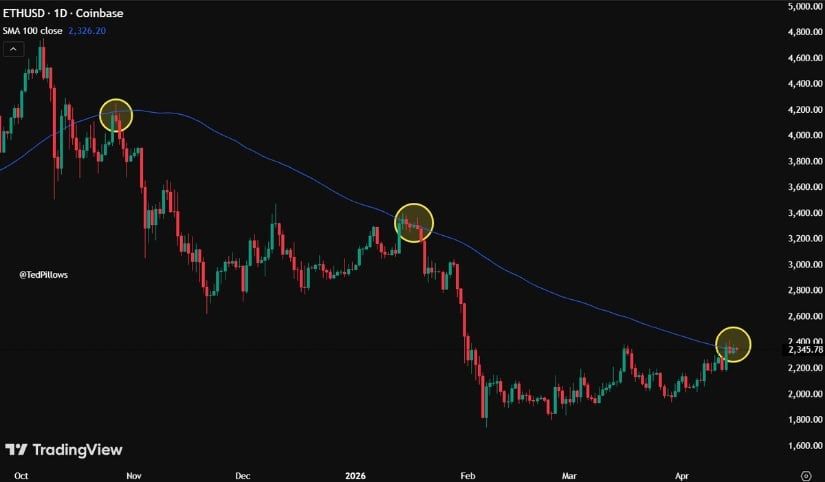
Look, the latest model chatter is all over the place. One Yahoo Finance recap of AI forecasts had ChatGPT putting ETH in a $4,000–$8,000 base case for 2026, while Claude sat way lower at roughly $1,620–$3,700. That spread tells you the truth fast: the model is not the story, the uncertainty is.
The annoying part is that people hear “AI” and assume precision. In reality, most ETH forecasts are just different ways of guessing the next move from historical price, technical indicators, on-chain signals, and sentiment.
What AI Ethereum price prediction actually means
Real talk: most people get this wrong.
AI Ethereum price prediction is usually a time-series forecasting problem. You feed a model historical prices, volume, momentum, and sometimes on-chain or sentiment data, then ask it to estimate future price or direction.
That can mean a few different things. Some models try to predict the next hour. Others try daily closes, weekly ranges, or a cycle top months out.
The method matters because a model that looks smart on a 1-hour chart can fall apart on a 6-month horizon. Research on Ethereum forecasting keeps showing this split, with short-term models often behaving very differently from longer-range ones.
The main model families people actually use
Here’s the thing: the model matters less than the setup, but the setup still starts with the model type.
There are three buckets that keep showing up in Ethereum forecasting work. Classical machine learning models like XGBoost and random forest handle structured tabular data well. Deep learning models like LSTM and GRU try to learn sequence patterns. Large language models like GPT-style systems are now being tested on price forecasting too.
That LLM angle is trendy, but it’s not automatically better. In one 2025 study, Llama-3 delivered the lowest mean squared error in short-term Ethereum forecasting on the Kaggle dataset, and Llama models also beat GPT-2 on another dataset. That sounds impressive until you remember this is still narrow, benchmark-driven research, not live-market alpha.
Deep learning is popular because ETH data is messy and nonlinear. Studies using LSTM, ANN, GRU, and RNN keep showing up because they can capture sequence behavior better than plain regression in many cases.
But wait, there’s a catch. A model that fits history too well can become a very fancy overfit machine. It looks brilliant in a paper and embarrassing in live trading.
What data matters more than the model
Honestly? This is where people mess up.
Everyone obsesses over architecture. The real edge usually comes from data quality and feature design.
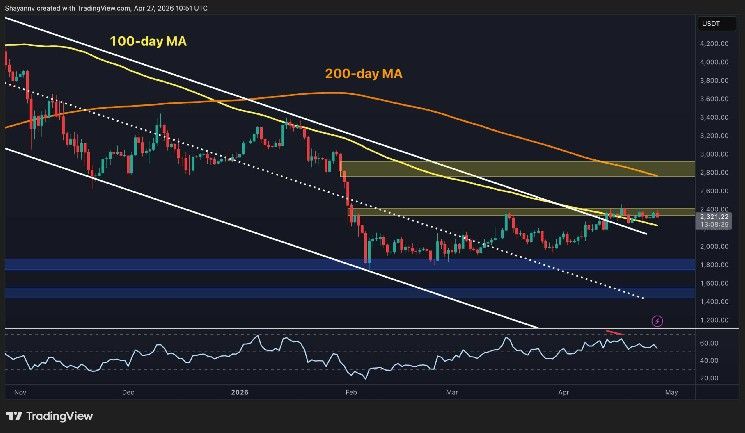
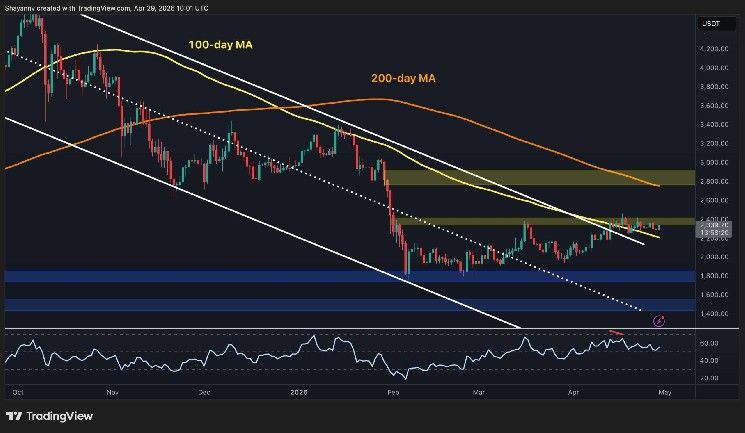
For Ethereum, the useful inputs tend to fall into four groups. Price and volume data tell you what the market already did. Technical indicators like RSI, moving averages, and Bollinger Bands help capture momentum and volatility. On-chain metrics can show network activity. Sentiment data from news, Reddit, and social feeds can add another layer.
A recent automation framework for Ethereum prediction in 2026 recommended combining BTC correlation, funding rates from derivatives exchanges, social sentiment from sources like Santiment or LunarCrush, and even macro signals such as Federal Reserve policy and real yields. That’s not because every signal is magical. It’s because ETH is tied to risk appetite, liquidity, and speculation all at once.
A separate forecasting study used sentiment scores from global news, Reddit discussions, and financial data alongside machine learning models like random forest, XGBoost, and LSTM. That’s the right instinct. ETH doesn’t trade on one variable. It trades on a pile of weak signals that sometimes line up.
Why the data pipeline is the real product
Stop pretending the model is the hard part.
If your pipeline is garbage, your forecast is garbage. Missing values, delayed feeds, lookahead bias, and inconsistent timestamps will wreck the result before the model even gets a chance.
A practical 2026 Ethereum automation framework says you should connect at least two on-chain providers, one sentiment source, and one derivatives feed, then orchestrate ingestion with tools like Airflow or Prefect. That’s boring. It’s also the part that decides whether your system survives contact with reality.
You also need feature engineering. Raw ETH prices are not enough. Models usually need lagged returns, volatility windows, volume spikes, BTC-ETH relationship signals, and regime markers so they can tell a calm market from a panic one.
If you’ve ever watched a team build a gorgeous model on dirty data, you already know how this ends. It demos well. Then it blows up in production.
How the research stacks up
Here’s the thing, the papers are useful, but you need to read them like an operator, not a fan.
One 2025 paper on Ethereum price prediction with large language models found that GPT-2 and Llama variants performed well in both few-shot and short-term forecasting, with Llama-3 posting the lowest MSE of 0.0027 on one dataset. That’s a decent sign that modern foundation models can help with specific forecasting setups.
Another study on deep learning for Ethereum used LSTM, ANN, GRU, and RNN models. That lines up with a broader pattern in crypto research: sequence models often do better than naive baselines, but the gains can disappear fast when the market regime changes.
An older conference paper claimed up to 85% accuracy for 7-day Ethereum prediction using historical blockchain and price data. Treat numbers like that carefully. Accuracy can sound huge while still being useless if the market is volatile and the payoff asymmetry is bad.
A broader cryptocurrency forecasting paper found XGBoost, MLP, and LSTM all producing useful results, with XGBoost and MLP outperforming some other deep learning setups on excess profit and accuracy measures. That’s a useful reminder that deep learning isn’t always the winner. Sometimes gradient boosting just does the job better on tabular features.
| Approach | What it’s good at | What breaks it | Real talk |
|---|---|---|---|
| XGBoost / gradient boosting | Structured data, mixed features, fast iteration | Weak on raw sequence structure without feature work | Great first model if you’re serious |
| LSTM / GRU / RNN | Time-series patterns, sequential dependencies | Overfitting, regime shifts, noisy inputs | Good in research, temperamental in production |
| LLM-based forecasting | Few-shot reasoning, flexible pattern extraction | Instability, weak calibration, unclear transfer to live markets | Interesting, but don’t crown it yet |
| Hybrid sentiment + technical models | Captures market mood and price action together | Data quality, latency, feature leakage | Probably the most practical path |
Why AI Ethereum price prediction keeps failing in the wild
The trap most teams fall into is believing historical fit equals future edge.
It doesn’t.
Crypto regimes change too fast. ETF flows, staking demand, macro liquidity, Layer 2 adoption, regulatory headlines, and liquidation cascades can flip ETH from trend mode to chaos mode in a day. That’s why AI forecasts for 2026 can range from conservative takes near $1,620–$3,700 to bullish ranges like $4,000–$8,000 or even much higher in other model roundups.
This is also why short-term forecast accuracy can look decent while actual trading performance disappoints. One AI price-prediction product reported 50.4% directional accuracy over its last 677 predictions for ETH, which is basically “slightly better than a coin flip” territory. Useful? Maybe. Enough to bet the farm on? Absolutely not.
And yes, some research reports stronger metrics. Another Ethereum forecasting paper using machine learning and deep learning claimed an R-squared of 0.982115 for XGBoost in one setup. Great. But R-squared on a historical dataset is not the same thing as surviving a live market with slippage, fees, and sudden news shocks.
The limitations nobody likes to say out loud
Look, here’s the uncomfortable part.
AI Ethereum price prediction is constrained by the market itself. ETH is reflexive, adversarial, and full of non-stationary behavior, which means the patterns keep changing under your feet.
There’s also the issue of leakage. If your training data accidentally includes future information, your backtest will lie to your face. That’s why walk-forward validation matters so much in this space. A simple train-test split is usually too neat for crypto.
Calibration is another mess. A model might be right on direction but wrong on magnitude. Or it might look good during trend periods and fall apart during chop.
Then there’s the human problem. Traders use forecasts to justify trades they already wanted to make. That’s not model usage. That’s confirmation bias with a dashboard.
What a sane ETH prediction stack looks like
Yeah, I know, another AI workflow. But this one actually needs discipline.
If you’re building something real, start with a baseline like XGBoost or LightGBM before you touch deep learning. Get your data pipeline clean first. Add BTC correlation, funding rates, sentiment, and a few on-chain metrics only after you know your labels are solid.
Then backtest with walk-forward validation. Not once. Repeatedly. If the model can’t stay upright across different market regimes, it’s not ready.
Here’s the order I’d use:
- Build a dumb baseline first.
- Add only the features that survive leakage checks.
- Test on multiple time windows.
- Compare directional accuracy, error size, and trading value.
- Retrain when market behavior shifts, not on a random calendar schedule.
That last part matters a lot. ETH doesn’t care that your model retrains every Sunday at 2 a.m. It cares whether the market changed overnight.
So should you trust AI Ethereum price prediction?
Real talk: yes, but only in the right role.
Use it for scenario planning. Use it to frame risk. Use it to catch weak signals humans miss. Don’t use it like prophecy.
The best AI Ethereum price prediction systems are usually hybrids. They combine technical data, on-chain activity, derivatives positioning, and sentiment, then keep expectations humble. That’s boring compared to “AI says ETH hits $15,000,” but boring is what survives contact with the market.
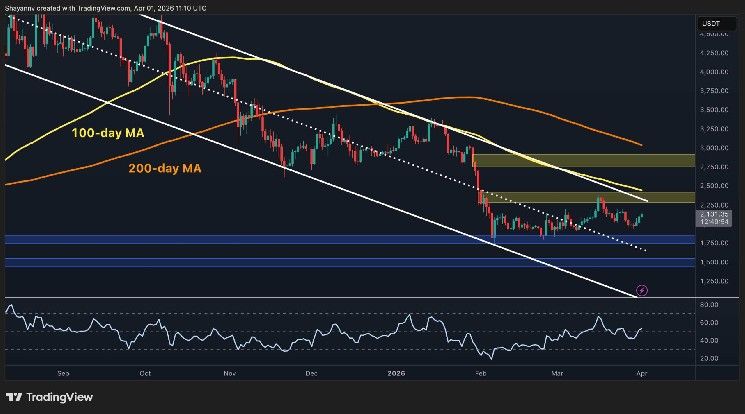
If you’re looking at 2026 forecasts, the gap between bullish and bearish models is the point, not a flaw. It tells you ETH is still highly sensitive to liquidity, adoption, and sentiment shifts. That’s exactly why model confidence should stay modest.
Real talk: AI can help you think clearer about ETH, but it can’t make the market less chaotic. Most teams want certainty. The market gives you probabilities and pain.
What are you actually trying to forecast with AI Ethereum price prediction: direction, range, or a trade you can live with when it’s wrong?